Elephant and Tailor Story with Moral
In one of the busy towns, one time, on the fringe of a big forest, there lived a beautiful elephant called Appu. Appu was not a mere elephant, he was the property of the king and during the processions he was asked to bear the royal family and he carried heavy ceremonial objects. His kind nature, his great power, and his profound intelligent eyes made him known to every one in the town.
Appu had to walk to the river in a certain path to take his bath every morning since the time he was at the stables of the royal household. This road led him right in front of a row of little shops. One of these stores was a busy tailors shop, belonging to a man by name Shankar. Shankar was not only a master of his craft, his needling was exact, his designs had been in demand with the nobility. But, notwithstanding his ability, Shankar was endowed with a malicious, petty spirit and he frequently played wicked tricks to amuse himself.
Appu would visit the shop of Shankar every day. Shankar, seeing the turn that the elephant always followed, had acquired a habit of his own, he used to reward Appu with a little sweet thing, a bit of sugarcane, or a ripe banana, or a ball of jaggery. Appu took it quite kindly through the door of the shop and with a kind rumble of thankfulness ate the treat, and went away, an unspoken covenant between the animal and the man.
This was a habit that provided Appu with some quiet contentment in his day during many years. Shankar, himself, was rather pleased with the exchange.
One hot afternoon, though, Shankar happened to be in a terrible mood. Shankar had been quarrelling with an assistant, his needles were sharp, and a customer had walked out on an expensive garment, a move that made him lose a lot of money and become annoyed. When Appu drew near the shop, and stretched out his trunk as was his habit, the eyes of Shankar were drawn in with sudden wicked malice. The appearance of the giant, peaceful creature in search of a good treat only added to his bad-temperedness.
Shankar took up his sharpest needle, rather than reaching a banana or sugarcane. At the moment the trunk of the elephant met the anticipated position, Shankar, with a swift, ruthless stroke of his wrist, plunged the needle, to the hilt, to the last inch, into the end of the trunk, which was very tender and sensitive.
Read More: Two Cats and A Monkey Story - An Animal Story with a Moral
Appu uttered a sharp trumpet of pain, so sudden and agonized that it startled them all in the market. The suffering was almost unbearable, not to mention the betrayal shock. Appu thrust out his trunk at once, and it was now swelling, and starting to bleed a little.
He stood motionless a moment, his huge ears waving slowly, his intelligent eyes staring at Shankar. It was not the appearance of anger, but of utter bewilderment and heart-rending betrayal. Shankar watched the agony of the elephant, and laughed--a sound of sharp coldness, not of any real joy.
Appu never immediately retaliated. He merely turned and walked out of the shop and his journey to the river and the prick of the needle and the bigger prick of the cruelty of the tailor made a permanent mark upon his memory.
Appu bathed that day, and took a long bath, and rested longer in the cool waters of the river, and the water of the river cured his wounded trunk and his wounded heart. He halted, as he walked back down to the stables, not at the tailor shop, but at a muddy puddle. He gradually filled his trunk, not with water, but with the muddy stuff that was coarse and stinking, and with the dirty water of the deepest part of the pool. He carried this heavy, smelly substance and passed the stores with new will and purpose.
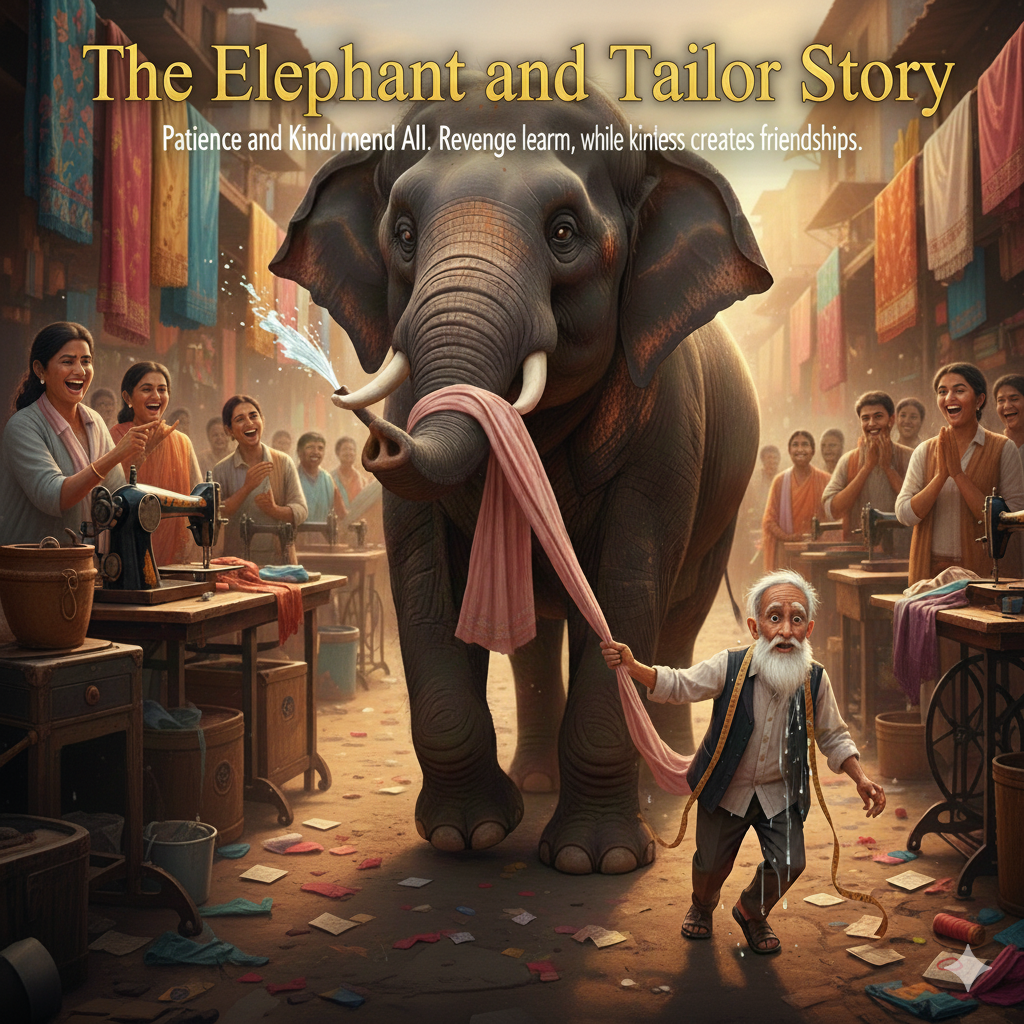
When he arrived at the shop of Shankar the tailor was engaged, intelligently showing several beautiful and freshly sewed velvet and silk garments to a fashionable customer, who happened to be wealthy. The labor was days of labor and hundreds of rupees. Shankar looked up and found Appu standing there, his huge figure in the sun. He smiled and hoped that there would be no penalty to his previous cruelty.
All at once Appu lifted his trunk high up in the air. Appu poured out the whole, thick mass of mud and nasty water before Shankar or his customer could make any reply. It poured down directly upon the brightly colored clothes and coated them with a thick, wet, sticky coat of dirt. The velvet had been ruined, the silk was stained irreparably, and the whole shop covered with stinking mud.
Shankar was screaming not because it hurt him, but because he was in utter despair and fury at the destruction of his means of earning a living. The client ran away, the expensive garments were torn, and the store was a mess. Appu just walked on, and his debt was used up.
The town folk, who were there to witness the first cruelty, and to witness the retaliation, shook their heads. They realized that Appu was not acting in malice, but a direct reaction to the betrayal that he has been subjected to. Shankar, who sat in the mud-wet ruins of his shop, saw the horrible end of his thoughtless rogue-like act. He had injured a friend without any cause, and, thus, he had destroyed himself.
Since then Shankar had a harsh lesson. He soon restored his shop and never again did he do harm to a living creature, especially to one that showed him benevolence. He had heard, too, that cruelty, when returned, will be more destructive than the momentary enjoyment of the act of malice.
Moral of the Story: The Power of Reciprocity
The parable of the elephant and the tailor provides a deep and lasting moral lesson as to what human interaction is and what the results of our actions are:
We are not supposed to pay kindness with cruelty, because whatever we do, whether good or bad, usually comes back to us multiplied by many folds.
This narrative obviously displays the concept of reciprocity, which means that the manner we treat people is likely to be treated the same way in the future. Although Appu ended up being dramatic and damaging in terms of revenge, it does reflect a very simple truth that even the sweetest souls have boundaries and they will always result in consequences of betrayal or malicious actions.
Practical Implementation: Applying the Tailor's Lesson
The moral of the elephant and the tailor is so much applicable to the conduct in social and professional life:
-
Workplace Ethics: Cruelty at work can be in the form of cutting words, malicious gossip, or sabotage of someone who has demonstrated any form of trust towards you. According to the story, this does not go unremembered. A betrayed employee can retaliate by withholding vital information or skills in future, and this will have a systemic impact (the destroyed shop). It puts a heavier emphasis on professional courtesy and integrity.
-
Social Media and Online Communication: This narrative is very topical in modern times. An online comment that is small and mean (the needle) may have a tremendous backlash (doxing), or a ruined career (the mud bath). It educates its users to stop and reflect on the irreversible and amplified effects of seemingly minor incidents of malice executed under a temporary sense of protection.
-
Creating Goodwill (The Opposite Moral): The tale has got a reversed effect as well. Had Shankar still been kind, Appu would have still been able to show goodwill and protection towards him. This teaches me that a reservoir of positive reciprocity can be created by the meaning of small acts and respect that can be drawn on when we need it most.
A Timeless Narrative: Why This Fable Endures
The tale of the Elephant and the Tailor has been passed on over the centuries by various cultures usually found in collections such as the Panchatantra. The simplicity and drama with which it described justice is its strength.
It confirms the strong humanistic assumption that betrayal needs to be answered and is a strong warning story about how one should not assume kindness. The elephant, Appu, symbolizes terrific authority and tremendous kindness, once the latter is infringed on, the act of the former is expeditious, rational, and commensurate to a crime of betrayal of trust. The lesson about the fable is that in the name of being nice it is always a choice, but as far as being mean goes it is imperative not to be cruel because the repercussions of malice are seldom within boundaries.