Two Cats and A Monkey Story - An Animal Story with a Moral
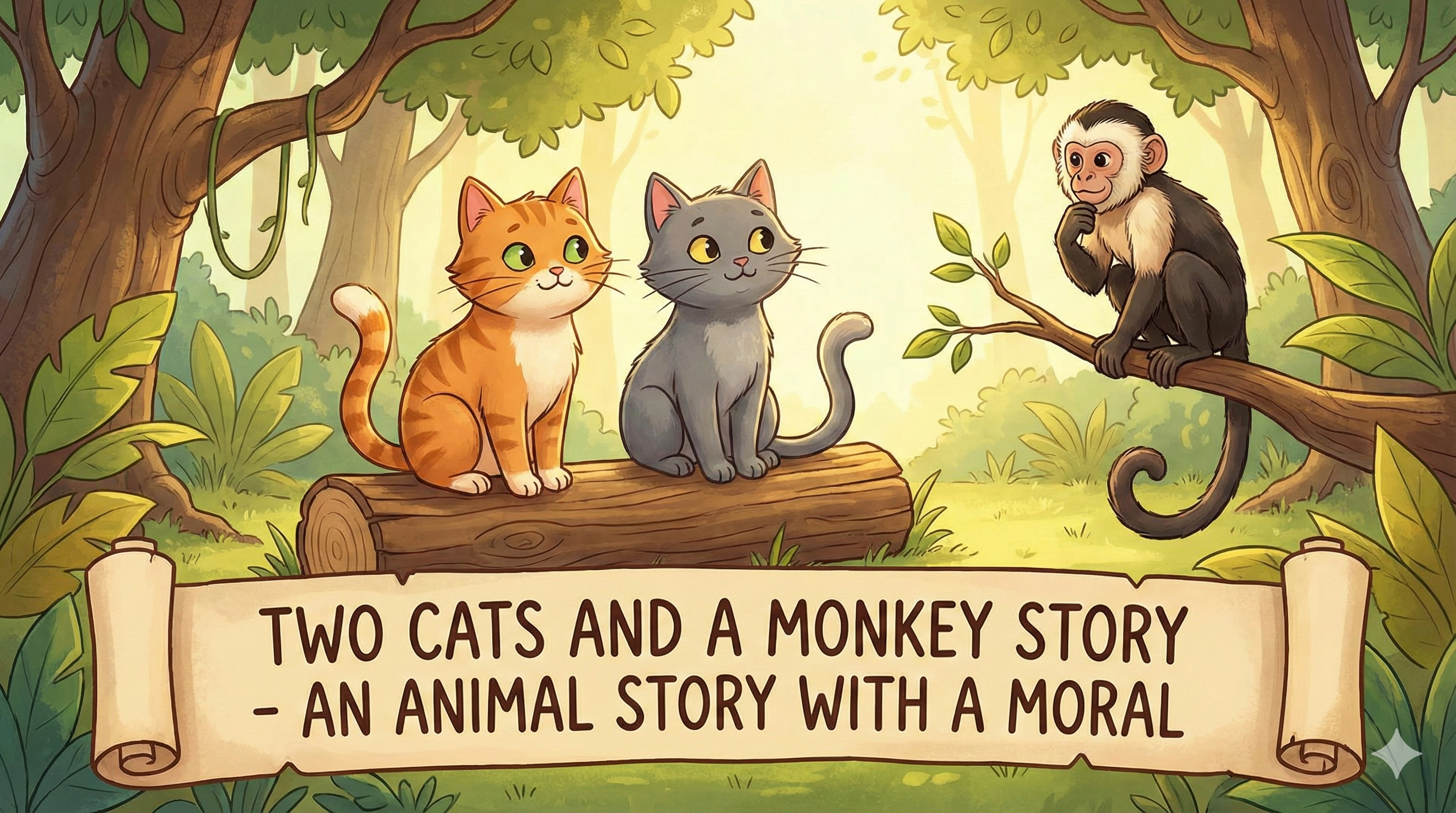
In a peaceful village within the midst of high coconut trees lived two cats, the closest friends, named Chikki and Mittu. Chikki was a smooth, calico, fast-witted and full of confidence cat. Her counterpart was Mittu, soft, ginger, tabby, gentle and thoughtful and instinctively generous, who thought that the best way to go was to share.
A routine of quiet walking about had been their days, in following village streets and waiting patiently on the scraps of food. Their friendship, however, was a good match, the boldness of Chikki being counter-balanced by the calmness of Mittu and her temper. This was the state of things and continued so, until the day when the friendship between them was subjected to a difficult test by the temptation of a contest.
One afternoon, as they were approaching the village market, when the air was full of spices and ripe fruit, the shrewd eyes of Chikki caught a glimpse of something unusual half-covered up: a loaf of fresh bread, the colour of perfect gold.

"Look! Food!" Oh, Chikki, her voice became shrill with so much excitement. There she sprang right down, and grabbed the prize in her paw before anybody, or any other animal, could dispute the prize. "Food!"
Mittu ran to her, with shining, green eyes. "Oh, that looks wonderful! It's enough for both of us. Let's share it right now."
Chikki hesitated. The loaf, and yet no large one, now appeared entirely lesser to her ideas, and to her the idea of sharing appeared to be a personal sacrifice she was not disposed to make. “Yes... share”, she thought, but the word was protruded slowly. But it simply is to be just.
“Of course”, said Mittu with a nod of her little head. We are going to divide it between us right down the middle, friend.
The time came for the parting. Chikki, under the impulse of a momentary burst of self-interest, cut the bread in two, and made sure that they could be seen to have been unevenly divided. One of them was a little, yet noticeably, larger and fatter than the other.
“That is larger," Mittu said mildly, while pointing to the piece which Chikki had snatched so promptly to herself.
The confidence that Chikki had changed to stubbornness instantly with her wish to get the portion a bit bigger. She scowled and explained herself, “It is just larger because of the way I tore it. They are exactly the same."
“No, no”, Mittu answered, and her voice was strong yet low. "Mine is smaller. Yours is clearly bigger."

This mere observation sparked-off a raging debate. The two cats clearly ready to start a fight, each in her heels, so desperate to get the slightest morsel to the other. Every sharp expression came with a tear at the canvas of their friendship.
A monkey by the name of Ramu was just passing by, at the very moment of their commotion. Ramu was a gunslinger, he had his reputation as being greatly shrewd at the village and notoriously looked for his own advantage most of the time.
“What is the reason behind this cat fight?” Ramu asked, falling carelessly with a practised, graceful swing on a low-lying branch of a tree, his eyes gleaming with interest.
The quarrying cats at once left off arguing, and sought the newcomer, in the hope that he would bring them fair and impartial decisions. “We have found this loaf of bread”, Chikki hurried on to explain, “We were to share it, but she is saying that my half is bigger!”
"And it is!" Trying to control the narrative again, Mittu insisted. “We only want flawless justice by a fair judge.”
“Fairness!” stroked Ramu with a dramatic action upon his chin. “An issue of paramount concern. You have really been fortunate that I have a certain knack to solving intricate distribution problems and rectifying things. I will weigh the pieces, and I will make them alike.”
He took up the two parts, which could not be equal, and commenced a necessary show, weighing them, in his hands, on an imaginary balance. He shook his head mournfully. "Hmm," he murmured with a sigh. “Yes, this bit, as I thought, is heavier. A grave injustice indeed."
Because the so-called hefty bit was bigger, Ramu quickly sank his teeth in it deliberately and loudly before either of the cats could counter the outrage or present an objection.
But as Ramu grasped the pieces again he furiously scowled. "Oh dear me. Now, by this irreversible kind of adjustment, this piece is now heavier. The justice scales take corrections on the spot!”
And, before the cats could make a single word of protest, he made an equally large bite at the other bit.
The ironic play went on, like a game of bluff. Every time Ramu insisted one piece of it had more weight, he compensated by a balancing bite. With each computation and each bite, the loaf of golden bread became smaller and smaller, wilting in horror, before the very frightened eyes of the cats.
Chikki, who is normally boldhearted, eventually started panicking. "Hey! Stop! We now have scarcely any bread left!”
Ramu slow-wittedly nodding keeping his seriousness in authority. “Fairness, my friends, requires a long and exact time. Patience is a virtue."
In a little time only one tiny crumb was left, enough to nourish a tiny insect. Ramu put the last piece of the bread in his mouth, and smiled at himself in a self-satisfied manner, and wiped his hands on the bark of the tree and said, “There. Perfectly equal. Mission accomplished."
“But... there is nothing we can eat now.” Mittu said to herself, the bitter truth striking her full in the face.
Ramu gave a cold shrug, and was quite indifferent. "Ah well. The next time round you have to decide more quickly amongst yourselves.” He said and then vanished, leaving the poor cats alone.
Chikki and Mittu sat in silence, observing the blank piece of dust-strewn ground upon which the golden loaf had disappeared. They still were physically starving and their starvation had only grown, but it was nowhere close to the painful, stinging sense of shame and loss in their hearts.

“We should have simply consumed it, rough or smooth, just as we discovered it,” said Mittu to herself.
With a leaden nod Chikki let go of her greed. "Yes. Our argument, our greed, it cost us everything we had found.”
They went away together; slower and wiser. They had now found out the bitter lesson, that bickering about petty differences and allowing greed to take root invited the predators and opportunists, and they became an easy target.
Moral of the Story: The Price of Greed
The tale of the two cats and the monkey is intergenerational. It touches upon a timeless lesson with uncomplicated directness:
We tend to lose the whole reward when we end up fighting over insignificant issues and letting selfishness and greed dominate.
There is no need to quarrel about small differences, take advantage of one another, and have outside problems or exploitation when it is always more appropriate to treat each other respectfully, equally and rely on each other.

Practical Implementation in Daily Life
The moral goes way beyond the distribution of a piece of bread; it is applicable in our daily life:
-
Sharing Resources: The basic lesson is the same: a long-lasting struggle is in the interest of no one. A compromise achieved fast saves time, energy and relationship health.
-
Sibling Rivalry: Parents may very mildly say, “Do you want to be like Chikki and Mittu and lose everything to the monkey?” This puts the argument in terms of counterproductive and not necessarily disobedience.
-
Teamwork and Collaboration: The success of the team is in the solidarity (the friendship) and not the exact split of the cake (the bread).
The story about Two Cats and a Monkey has survived many generations and will always stand the test of time due to the appeal to a universal human weakness of the paralyzing power of petty greed.
A Timeless Narrative
It is a vivid, but not a judgemental, reflection on ourselves that makes us realize we lose sight, just like in the story.
It is a simple equation presented in an engaging animal format:
Greed + Stubbornness = Conflict = Vulnerability = Total Loss
It teaches that the relationship (friendship between Chikki and Mittu) is always more valuable than the commodity (the golden loaf of bread). This is not merely a moral teaching of sharing, but a moral teaching of first putting peace, friendship and compromise before the devastating illusion of absolute, self-serving justice.
What is even more pitiable is the last picture, two starving and embarrassed cats awaiting the vacant area, where we learn that, when we have given over to our lower nature, the one who really wins is the monkey who capitalizes on our lack of unity.